Showing posts with label trekking. Show all posts

Wednesday, 15 May 2019

Life at Everest Base Camp

Just over three weeks ago I left Everest Base Camp (EBC), leaving Robin to tackle his adventure, and it feels like it’s been a lot longer. With two thirds of the Everest climbing season finished, the teams are waiting patiently, and now anxiously, for their “weather window”, the first of which is taking place now (May 15). With several teams high on the mountain as I write, there are still a good number waiting at Base Camp for a longer opportunity to achieve their dreams.

Most climbers descend to lower villages to sleep in a real bed and have real showers when there are long chunks of time without much to do; however, as per my previous posts those beds and showers are still a far cry from first world expectations. The bulk of their time since late April has still been spent at EBC. So, as a self-declared expert because I stayed three whole nights at the heel of the Khumbu Glacier, I thought I’d enlighten you on what you can expect from life at EBC.

 Our Summit Climb EBC Tents

With our chosen expedition agency, we experienced a little bit of "Instagram vs Reality" as many of the posts under #everest2019 which I had been following have been from the larger, more expensive expeditions. Life at EBC when you spend over 70K of any major currency is certainly more comfortable than when you've gone the budget route. Disclaimer here that the budget route is still a small fortune where that money could be a nice down payment on a house. The adage goes "you get what you pay for"; however, I'd argue that you don't get what you don't pay for in this instance. I must also declare that we were/ are well looked after with shelter, food, Sherpa and smiles, so it's not like we were hard done by.

So what is it like? 

Map of EBC courtesy of AlanArnette.com

Everest Base Camp is set on the heel of the Khumbu Glacier, where the ground is mainly rocks vs. glacial ice. A glacier being a dynamic environment, the camp shapeshifts throughout the climbing season. As per my fellow teammate Ian's account from his blog :
"My original tent had become largely uninhabitable as the glacial ice beneath it melted, creating a small 2ft x 5ft plateau in the center of the tent that I slept on in the fetal position, while the rest of the tent (and my gear) sagged below me by a couple feet."

The tents of various shapes and sizes are set atop the rocky base where the Sherpa team arrive before the climbers to try and smooth out the ground as best they can to set up the tents for the climbers’ arrival. There are clusters of tents arranged according to the expedition agency spread across about a 2km length and ½ a km width. The tents within the expedition group are relatively close together- let’s say if you thought the noise carried in the Tea House plywood walled rooms, you’ve got even less privacy at EBC. 

 EBC panoramic view. Tents to the left, right, and behind me.

Personal tents are of the domed, spacious 2-man nature allowing space for one fully grown white adult male, average age 40 (typical demographic) and his 2 large duffel bags. Squeeze a partner in there and you quickly boot one of your bags to the porch of your tent. If you paid for the premium expedition, then you have a rectangular tent where you might be able to stand up. If you paid for luxury digs, then that might even have a small generator-powered heater or at least at turn down service including hot water bottle in your sleeping bag when you return after dinner. 
 Insta vs Reality: what your money buys you

Common room tents include the kitchen tents, separate from the meal tents, separate from the yoga/ movie theatre tents and increase in size. The first two tend to be of the barrack, rectangle style, the latter is a big old dome with a window frontage overlooking the Khumbu Icefall. I can’t say that I personally saw the dome tent of the Climb the Seven Summits team, but I have seen this on Instragram. Again, Instagram vs. Reality: Posh camping has tables, chairs with backs, rugs, and generator heating. Reality of your budget trek: tables, tarps, camping seats, and heating generated by body heat… oh to be fair, also a heater that sits on a gas bottle.

Everything except the kitchen sink... because it doesn't exist. The budget way of working.


Climbing the Seven Summits Common Tent

There is one other style of tent that is dotted around EBC, and that is the toilet tent. As you would expect, a 2m tall, 1m x 1m base to give you some privacy as you go about your business. The tent and base are elevated with a collection receptacle underneath. Reality camping means a quad workout as you squat over a plastic barrel used to capture the waste, and brought down the mountain at a later date (you think your job is bad!). Posh camping you get a makeshift seat built up above the barrel. The toilet tents are usually down wind/ stream/ hill of the camps; however, your camp might be down wind/ stream/ hill of another group’s facilities.

We took a tour de base camp on our first morning which allowed us to take in the scale of the temporary village, as well as the scale of the 7000 - 8000m peaks surrounding us. One enters EBC off a main path, which then splits up and down the slant of the land. This path is frequented by expedition members trying to find their facilities, but also yaks bringing supplies to the groups daily.
 Pony express in this case. The major highway was just at the foot of our tent.

Natural surroundings 

There are natural sculptures of rock on ice dotted throughout the camp reminding you that you are a visitor in a natural environment. The camp is lined with relics of the glacier, towers of ice and snow acting as a playground for the aspiring summiteers to train. You are absolutely dwarfed by the sheer scale of the surrounding challenges, and yet the top of Everest is still not even visible. What you do see are seracs delicately hanging off the sides of Nuptse to the right, Everest to the left, and Pumori at the back (as you face the Khumbu Ice Fall); you might even see, and you certainly hear, avalanches breaking from these seracs throughout your stay at EBC.

He's going that-a-way: over that ice fall and over to the left behind that peak


This rock was the size of a small car.


The purpose of the tour de base camp was to seek out some of the potential luxuries and necessities that we might have access to: WiFi and Medical Help. In the center of the village, up from where our camp lie, there are both an ER and satellite communications tents. Just outside of the comms tent, there is a rock, now dubbed ‘WiFi Rock’ which is the only place our team is able to get any sort of 3G/4G reception. This allows for patchy whatsapp calls, descent whatsapp text messaging, and yet does not really allow for upload of photos nor video. If you do sweet-talk or likely bribe one of the people manning the comms tent, though, you might just be able to update your Instagram. Alternatively, you can choose to walk 1.5 hours down/ 2 hours back to the nearest village Gorekshep which does have a reliable internet signal. Queue another dose of Instagram vs Reality here where it seems that the majority of the pictured posts on Instagram are coming from the luxury expeditions which leaves me to surmise that they have their own comms tents… again, you don’t get what you don’t pay for, or in this case you don’t get what you pay for when the WiFi card costs $75 USD for 2GB of data.

 ER tent rates. Selfies $5.


Surroundings described, how is the time passed, you ask?


When expedition members aren’t practising their jumarring or taking part in an acclimatisation hike up one of the surrounding monoliths, there is plenty of time to get some R&R within the regular schedule of basecamp meals. Breakfast at 8:00am, lunch just after noon, and dinner at 6; each meal prefaced with a selection of hot beverages. I rediscovered hot chocolate, or hot chocolate water during my time at EBC, where in wishing to remain hydrated and avoid the hard caffeine of tea or instant coffee, I tipped some chocolate powder into my stainless steel camp mug with hot water and relished in the emotional warmth of the chocolatey extra calories.

Meals in our camp were pretty tasty, and consisted of extended versions of what we had eaten on our trek up, minus the cakes and in our case, replaced with a few pieces of tinned fruit. If you paid the premium prices, I did see a few instances of gas-powered ovens in kitchen tents. If you paid for luxury, the rumour is that top chefs are even flown in to prepare a few meals for the patrons. I couldn’t comment on the amount of variety, as the three days in which I was at EBC, the only repeats that I ate were from the communal coconut biscuit/cookie pile and tinned fruit dessert. 

After breakfast we were urged to turn out our sleeping bags and hook them to the outside top of our tents to allow them to air and dry. As you exhale in the frigid air of the night, your breath is captured and suspended within the confines of your tent. When you wake up and move about, you undoubtedly knock the fine crystalline layer onto your sleeping bag and jackets. As well, the warmth of the sun from 7am onwards tends to melt the crystals which now become like a dew. In addition to your sleeping bag, other items you would choose to expose to the heat and light are your camping mats, washed (or not) laundry, and solar batteries leaving the camps to look a bit like a yard sale. You might go for a walk to WiFi Rock, you definitely sit outside to enjoy the warmth of the sun. You might choose to take a shower from the bag of hot water the Kitchen Staff will fill for you in the shower tent (similar to the toilet tents). You might choose to recoil from civilisation as your head could be pounding as it acclimatises to the lack of available oxygen in the air. 

Between lunch and dinner, as the temperature begins to drop, you reassemble your tent, use the light and warmth to assess your clothing situation for the following day, take some time for yourself to read or write, and/or begin to speculate with your fellow team members on how to solve the many problems in the world. Remembering the typical demographic at EBC, one might argue that these perspectives are not going to be THAT different from those of the majority political powers making decisions today. 


Somewhere near 5pm, you might migrate to the dinner tent to get a good seat and sneak in a hand or two of cards before the first of your three course dinner is served (soup + main meal + tinned fruit). After dinner, you certainly stay a little while longer to play more cards and listen to the plan for the following day. The main motivation for hanging around after dinner is that the dinner tent is warm comparatively to your lonely personal tent. Warm with company, but also physically warm. By the evenings the temperatures have dropped below zero. Getting changed (or not) to get into your down cocoon IS brisk, and lonely once you’ve tucked in for the night.
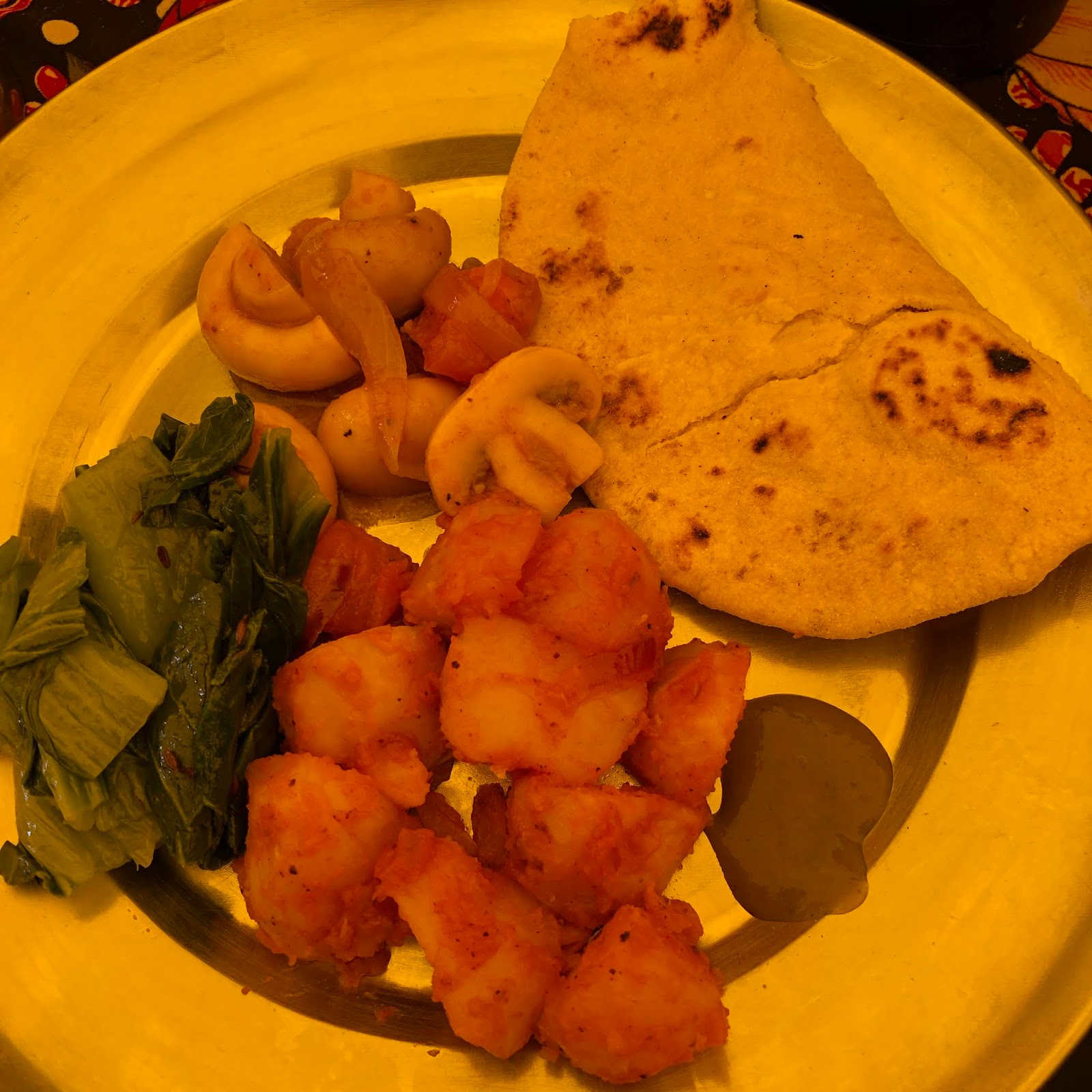
Dinner example

Circa 8pm, most of the camps are quiet- that mountain air does tucker you out! If you choose to emerge from your tent for some reason (like you don’t have a pee bottle), it is surprising how light the environment appears. Moonlight reflects off the surrounding snow caps and glaciers, allowing you to manoeuvre around the camp without the need for a head-torch. Tents are lit like lanterns by the head-torches of climbers who are not yet ready to catch their zzz’s.


Everest at night

If you weren’t ready for bed at 8pm, then you might spend a bit of time reading or watching whatever viewing device you brought, stocked with downloadable content, powered by the portable batteries that you charged in the morning daylight. Eventually you tire, likely from the lack of oxygen outside and inside your tent, and you fall asleep. Even as you sleep, you notice that it's difficult to breathe. Just shifting within your cocoon from one side to the other to prevent that jagged rock underneath from bruising your hip or shoulder, you are left panting and taking big gulps of air for the next few breaths.

In the night the camp is quiet from human activity and the sounds you do hear are the deep rumblings of avalanches and the ice cracking beneath you. You hope these are sounds of your dreams, but you confirm with your fellow climbers in the morning that you all heard the same normative yet frightful sounds. 

This is an account of my few days spent at the heel of the Khumbu Glacier and although it was only a few days, it gives you an insight to the month that potentially 800+ people are experiencing during the Everest climbing season in Nepal.


Friday, 26 April 2019

Our latest adventure: Namche to Everest Base Camp

Writing you on my way home from experiencing the outdoors and city life that Nepal has to offer, I thought I’d pick up where I left off (mid trek), and take you along the rest of our journey. Time really does fly, and it’s hard to believe that I did leave you in Namche over 10 days ago. So, what was the rest of the trek in to Everest Base Camp like?


April 13, 2019: Namche (3440m) to Pangboche (3950m) via Tengboche (3875m).


This was due to be one of the longer days on our journey: 13km more. We were briefed it would be 3-4hrs to Tengboche and then another 2-3hrs our rest stop. Although on paper, it seemed like a gentle climb of 500m up with 100m down, this is where we were introduced to the Nepali Downhill.  The Strava account informed us that on the first portion of the hike alone, we did 9.4 km with 900m of elevation gain spread over the undulating hillside. No wonder I felt absolutely bagged by the time we reached our half-way time point. 

Tengboche, although small, is known for two reasons: a Buddhist Monastery and excellent bakery. In fact in all of the media Robin and I consumed, we saw the bakery in an episode of Everest Air Rescue. Not for undue reasons, rather that one of the junior helicopter pilots was sent to pick up a birthday cake for the rest of the group. I don’t blame him! I would not want to do that hike again if I didn’t have to and the cake was deeee-licious!


We had our cake and ate it, too as we waited for Dawa Choling Gompa to reopen after lunch. Basic from the outside and incredibly ornate within. I will ask you to use your imagination as there were no photos allowed, but beyond the coloured Chinese gate, past the white facade dotted with dark brown trapezoidal windows, a courtyard led way to the main interior meditation room. So brightly coloured as it was recently (in the mid ‘90’s) restored after a fire, the walls depict various allegories from Buddhist history. Feeling grounded from the visit as thousands of past trekkers have who have made this visit, we continued forth.


The scenery for our 4hr/1.5hr split was much of the same as the first days, with the dirt/ stone pathways, dotted religious stones (now I know are called Mani stones), and yak-dodging. Unfortunately, we lost the views in the steadily moving clouds taking away the upper mountains which surround us as we trek. This was also to be the last day of trees as we made our way higher to the heavens. 

We arrived (bagged, well at least I was, as mentioned) to our one night home called the Sonam Lodge in Pengboche. The standard of accommodation certainly declined since Namche, and everything is far more rustic. You can read more details about the Tea Houses in my previous entry. 

April 14, 2019: Pangboche (3950m) to Dingboche (4410m)

We started the day with our usual briefing to learn our next village should be a 3-4hr trek, so when we arrived in Dingboche in just under 2 hours, we were pleasantly surprised (and relieved!). The Yak Hotel and Restaurant would be our home for two nights.

As mentioned, today the terrain changed. We said goodbye to the trees. There were now large boulders amongst lower shrubs and slopes of large rocks to the sides of us. The weather changed, as well. It was time to unpack the warmer layers as the warmth from the sunshine quickly passed early in the day to leave us with wind, clouds, and a hail storm.


En route we had heard news that there was a crash killing 3 people at Lukla airport. The desire to know got the better of us and we spent $5 on the Tea House WiFi to find out the details: the crash happened leaving three deceased (co-pilot and two ground officers) when a crew-only plane lost control on the runway, veered to the wrong side and collided with two stationary helicopters. This was certainly a stark reminder of the dangers that lie ahead on the return to Kathmandu. 

We spent the remainder of the day in what would prove to be “bustling” Dingboche searching out good bottled water prices versus those at the Tea Houses (to be found at “The Best Shop” in Dingboche), drinking Bailey’s hot chocolate at one of the local bakeries (glad I had so much money for chocolate cake), and huddled around the yak-poop stove reading to keep warm.

April 15: “Rest” day in Dingboche (4410m)

Rest day actually means acclimatisation hike day, and based on the previous acclimatisation hike, I should have taken caution rather than thinking it would be an easy day.  

At the back of our hotel we saw the impending doom of switchbacks up the steep gradient with what might look to be a never ending hill. This hill in the end was a 2.5 km set of switchbacks with 700m elevation gain at 25-30% incline. Okay, so stairs are typically at a 30% gradient, but imagine doing 2.5 hours of stairs with just over half of the amount of available oxygen in the air... this training will make me faster, right?! 


Relief came in a few ways: the weather was fabulous allowing us to see the beauty of Ama Dablam and the surrounding snow and rock landscape of 7000+ meters; we met a flag-capped summit of whatever molehill we just climbed allowing an actual sense of accomplishment to be felt; I had some emergency chocolate to hand (Cadbury Boost) and man, did that do exactly as it said on the tin! We snapped our practice summit pictures, relished in our chocolate break, and then headed down to Dingboche to rest for the rest of the rest day. 


Not only does Dingboche host “The Best Shop” (every village has its own), it also hosts what I would say is “The Best” cafe of the excursion: Café 4410. A coffee shop that would fit in anywhere in the Western world. Many trekkers pass the time at Café 4410 drinking their NYC-priced latte and eating their apple pies (viable source of much needed fibre) whilst waiting for their phones to charge (free with purchase). Time is also passed by blogging, reading a variety of famous climbing books or playing hours of board games: Monopoly, chess and Jenga being the most popular games.


April 16: Dingboche (4410m) to Lobuche (4900m or 4930m or 5030m depending on which sign you read)


We seem to have gone off piste to the “itinerary” here, bypassed what was a scheduled overnighter in Dugla, and continued onto our next town, higher than any point in Western Europe. Another 3-4 hours of an 8.3km trek with 600+ m of steady upwards elevation, the greenery has now all completely vanished and we are left with boulders along the carved river valley that we follow. Clear skies allow us the views of the surrounding peaks and to feel the strength of the sun in the thinner air. 

We pass the sobering and monumental Climbers’ Memorial, an area decorated with flags, Mani Stones, and plaqued altars. The names of previous climbers who have lost their lives pursuing their endeavours within the Himalayas are presented on these hand-stacked altars dotted around the hillside. There are names of the outwardly well-known, in addition to the everyday men and women who met their fate at the mountain, not just at Everest. We pay respect to the lost climbers, as well as to the mountain before continuing forth.


Entering into Lobuche, we are familiar now with what to expect…. Check-in point, sign saying 6km to EBC (so close!), The Best shop, The World’s Highest Bakery, and a few Tea Houses looking more and more basic. There is rumour that there is a “posh” Tea House here, which Robin and I go to check to see if it is worth staying the night. It’s a little warmer, friendlier, and more brightly painted, perhaps reminiscent of the earlier Tea Houses along the way. However, we decide to stick to the group and stay our one night at Above the Clouds before departing to my end goal the following day.


April 17, 2019: Lobuche (5030m) to Gorak Shep (5164m) to Everest Base Camp (5364m)

We are off to EBC!! 

Slightly nervous based on my Kilimanjaro experience and because as we upped the ante each day resulting in a slight headache, as a precautionary measure I started on the Diamox this morning. Half a tablet, twice a day (based on my body size) should thin my blood just enough to relieve a slight pressure build up in my head. I found that from about 4000m onwards, I’d finish the hike with a headache that would subside after drinking 1L of water and having a nap, and I would feel fresh (except for heavy legs) the next morning. 


We woke up to a cold (-3C) and snowy scene, which meant two things: one, I had all new, clean clothes to put on which I had been saving for the colder temperatures and two, for the duration of the hike, we would here reference to being “North of the Wall” possibly as it was also nearing the premier time for Game of Thrones.

Although the air was cold and snow afoot, the morning sun was strong and as we set out from our last bed, many of us overheated in about 10 minutes. I was certainly starting to feel fatigued from the past 7 days of ascent. As we were at the back of the pack, our supervisor Sherpa Jangbu offered Robin, myself and two others an alternative route. Hoping that this was going to be a shortcut, we followed dutifully. It turned out Jangbu wanted to show us a picture point and hidden gem of a Tea House tucked away from the main path (and to say hello to some of his fellow friends). We had a beautiful view of the mountain Pumori, and a teaser of “what we could have had” for a Tea House. It turned out the 8000 Inn is a more upmarket Tea House (still basic vs a hotel) coupled with a research station. This was where the National Geographic Team were staying en route. 

After our photo stop, we continued to follow Jangbu along the back route: a side hill ridge route with a path only just big enough to hold both feet side-by-side at the widest points before plunging 400m down the valley to the conventional path where we could see the rest of the trekkers. Last time Robin and I walked this type of route, we had crampons, an ice axe to hand, and safety line between us (similar to what was the Grand Couloir on Mont Blanc). Dry dirt covered by about 3 cm of sticky snow now melting in the sun made for some precarious footwork. Each step was deliberate and anchored by walking poles planted to the front of our bodies acting in safety if we should slip. There was no sense nor time to panic or we may slip down the face into the valley with no chance of stopping ourselves. The two split seconds I felt comfortable and shifted by attention were coupled with heart-racing wobbles. It took us about an hour to get across this part of the path. Oh, and the route was 1km further than that of our fellow trekkers!


The Jangbu group of four were briefly reunited with our fellow trekkers at Gorak Shep, a village of a handful of establishments en route to EBC. We stopped for lunch and respite just as a the others were leaving. Refuelled, warm, and with a headache coming on, we geared up and proceeded to our destination. 

About 90 minutes and a final slowly, slowly, step-by-step climb later, we made it to EBC! 


We found the decorated rock to take our pictures, waited our turn, and jumped in. The pictures we took are a testament to how tired I must have been because they were awful. The only sense of relief was that we were nearer to our tent. The whole event felt ever-so anticlimactic. This would be/ should be an achievement of a lifetime to many people, and yet the feelings of accomplishment for such a feat were missing. Perhaps because I’ve done bigger things, perhaps because I managed my expectations too well. I have felt in the past accomplishment comes when I have surmounted my expectations.  As well and partially because of what I alluded to earlier, EBC is NOT the top…. there are still thousands of meters more. Not that I am ungrateful for the past week of rich experience, rather that rationally I know it’s not the finale. We’ve set the scene. Act I is complete. The protagonist, Robin, will continue onward and upwards through Act II and the Finale over the next month. As I write this last sentiment, a smile comes to my face as I feel excited and proud of the endeavor he has on his plate. I’m sure the missing sense of accomplishment will come when Robin has finished his story. 


Friday, 12 April 2019

Our latest adventure: Mount Everest (with pics!)

I know it’s been a long time, not because I haven’t had anything to literally write home about, rather that I haven’t had the mindset to compose an entry. It’s been a busy 18 months; we’ve been to Brussels and back, and within a month of re-stabilising in Birmingham, I am now reporting from the Nepalese Himalayas, about a week into our epic adventure. Robin is off to the top of the world and I’ve accompanied him on the trek into Everest Base Camp. I thought it would be great to document our journey as we go along: as technology has moved along, I’m able to ditch the scratch pad for an iPad mini and use the Tea House WiFi along the way. 

You can follow @xtynspix and https://www.instagram.com/1c0n0clast22/

So here’s how it began:
April 6, 2019. London to Dubai.
After a civilised touristic day in London, we made our way to Gatwick Airport with 4 duffels equating to 80kg of Everest related kit (and snacks) to check in- only 17 of which was mine. The very kind lady at check in spared charging Robin for the extra 5kgs. However, what we saved here was lost at the last minute currency exchange (🤦‍♀️) buying USD and whatever Nepalese Rupees were in stock. Eventually on to our Emirates flight to KTM via Dubai- and the flight was far more comfortable than I expected. Quite good seat space, a nice fleecy blanket and good wine. A 6ish hours flight with 3ish hours of cattle class airplane sleep later, we arrive in Dubai. 


April 7, 2019: Dubai to Kathmandu 
We spent 45 minutes of a 4.5 hour layover in Dubai transferring to the budget air terminal where our flight to Kathmandu was departing. With not a lounge to rest our heads, nor a double seat, we purchased some snacks and did laps of duty free before our flight to Kathmandu left. 

The arrival in Kathmandu was as expected for a “holiday” country: line up to fill in a paper form, then line up to input the details of the paper form into the visa processing computer, then line up to pay for the visa, then lastly, line up to go through passport control. By then our 4 black duffel bags were waiting amongst the other black trekking duffel bags for us to pick up. We hauled them on a trolly and met our first porter to take us to the hotel. 

About 30 minutes of driving in what seemed to be a lack of traffic rules, similar to playing Toad’s Turnpike in reverse mode, we arrived at Hotel Shakti in the Thamel district. Indeed our last night of luxury for the next while was in our hotel in London; but it’s also likely that the 3* (2* western standard) would be luxury after what was to come. We walked out and around the corner to get some dinner with other Everest Aspirationals who will join Robin, before showering with the toilet and tucking in for the night. At least (we each) had a bed which was better than sleeping on the plane.

April 8, 2019: Kathmandu 
Woke up for our 8am briefing where we were amongst maybe 40 other Summit Climb patrons. We shortly learned that there were other tours happening in addition the the Everest ones that Robin and I booked. Many people were doing Cho Oyu, what is meant to be an “easy” 8000m peak. There were also several guests taking part in Everest Tibet and North Col attempts. Our direct group consists of 16 total trekkers coming from Belgium, Canada (that’s me😝), France, India, Iran, the UK, and the USA: Robin + 4 other Everest Nepal side climbers, two Island Peak climbers, two Lhotse peak climbers, 6 Everest Camp 3 climbers, and one additional base camp trekker to me. The mix consists of 1 guide, as well as an additional set of Sherpa who we collect along the way. The term Sherpa refers to the native people from the Khumbu Valley region. They are our support staff on our journey from Kathmandu to the top of the world. 

The company owner, a man with a gentle, smiling handshake yet a repertoire of deadpan, random one-liners, took us through some top tips, reviewed the kit list, and disseminated the difference between Imodium (just a plug for your butt) and taking different antibiotics when you get an upset stomach because you opened your mouth in the shower. Other top tips included how much cash to take depending on if you go to Tibet or Nepal (you need a minimum of $1500 to get a rescue jeep in Tibet vs in Nepal, if you want to have fun, meaning tea and chocolate cake at each village, bring $10 a pop), and to take Diamox starting now if you don’t want to be reading your kindle in your tent while everyone else is having a good time. Of course, one last helpful warning to those going for their different summits: beware of “Summit Fever”, that insatiable need to get to the top, even when you’re not feeling well, and you think “it’s just there” then you fall over, and DIE. Essentially, we listened to some well-learned warnings into the tone of light humour before signing our savings away in case of emergency.

After our briefing, we found out there was a 12am lobby call due to our flight being rescheduled to another airport a drive away. Recently, Kathmandu air authorities have cancelled all local air traffic to Lukla to prioritise international air traffic,. Bad news as that meant it was likely to be a poor night’s sleep. More bad news, the next airport was a 4 hour drive  away. 

Onwards and outwards from the hotel to brave the chaos of Kathmandu for a spot of gear shopping and rupee exchange (feel like a baller with my wad of 1000 rupee notes; 1000 rupees = about $10 usd). We were greeted with many familiar sites as found in other non-western cities: hole-in-the-wall tuck shops, tuktuk vs taxi vs scooter travel, and souvenir shops galore set upon the dirt/cement roads and amongst the brick and corrugated metal roof tops. 

With our tasks finished, we took some time to be tourists and put our lives in the hands of our taxi driver who drove us to the Swayambhunath Temple, which is well known for the monkeys which occupy the grounds, in addition to the hilltop view over Kathmandu.


Back to the hotel for our group dinner, bag packing, and then one last shower for an uncertain number of days as we’ve been told it can be random as to when we will be reunited with our bags. Top tip: bring a backpack/ sleeping bag combo that allows you to also have your water, snacks, and spare clothes. It was Robin to the rescue for me as my backpack was too small or my sleeping bag too large to accommodate extra clothes or snacks. I bet you can guess which I prioritised. 

April 9, 2019: Kathmandu (1400m) to Ramechhap (1619m) to Lukla (2845m) to what should have been Phadking (2610m)
We started the day before going to bed loading the van at 1230am to drive to Ramechhap airport, or should I say, airfield for our flight to Lukla. Lukla is renowned for being one of, if not the most, dangerous airports in the world as the 527m runway is set in between two hillsides. However, the drive there was potentially even more dangerous.

The drive is probably best to take at night so you don’t see the direct danger you are driving through... or perhaps the trekking company wanted to save on a hotel night. The driver slalomed our way up and down and eventually up again to our airfield. These roads are unlike anything I’ve ever seen before- it’s hard to tell if they have been damaged by the 2016 earthquake or if they were never built properly in the first place. It seems as though much of the infrastructure in Kathmandu, and up to Lukla so far, is rubble, pot holed, and down-right collapsing.


After having a breakfast box only rivalled to that provided at the infamous Fyre Festival, we luckily boarded our plane within the hour or so of arriving (there was a threat we’d be there all day). Larger backpacks were loaded in the hold with the duffels and some day bags made it in the 24-seater cabin. Unfortunately, some bags were loaded elsewhere... so elsewhere in fact that they ended up on other planes. Unfortunately Robin’s day bag was one of those bags. Instead of pressing on to Phadking, it was decided that the group will remain in Lukla for the night to wait for the 20 awol luggage pieces, putting us a day behind at the start of the itinerary.

Ramechaap Airport. Summit Air planes

Lukla Airport runway.

How did we spend our day in Lukla? We caught some missed zzz’s, got caught in a mule/donkey traffic jam, and learned the Iranian version of Crazy 8’s (Dirty 7’s) before dinner and an early bedtime.

April 10, 2019: Lukla (2845m) to Phadking (2610m)
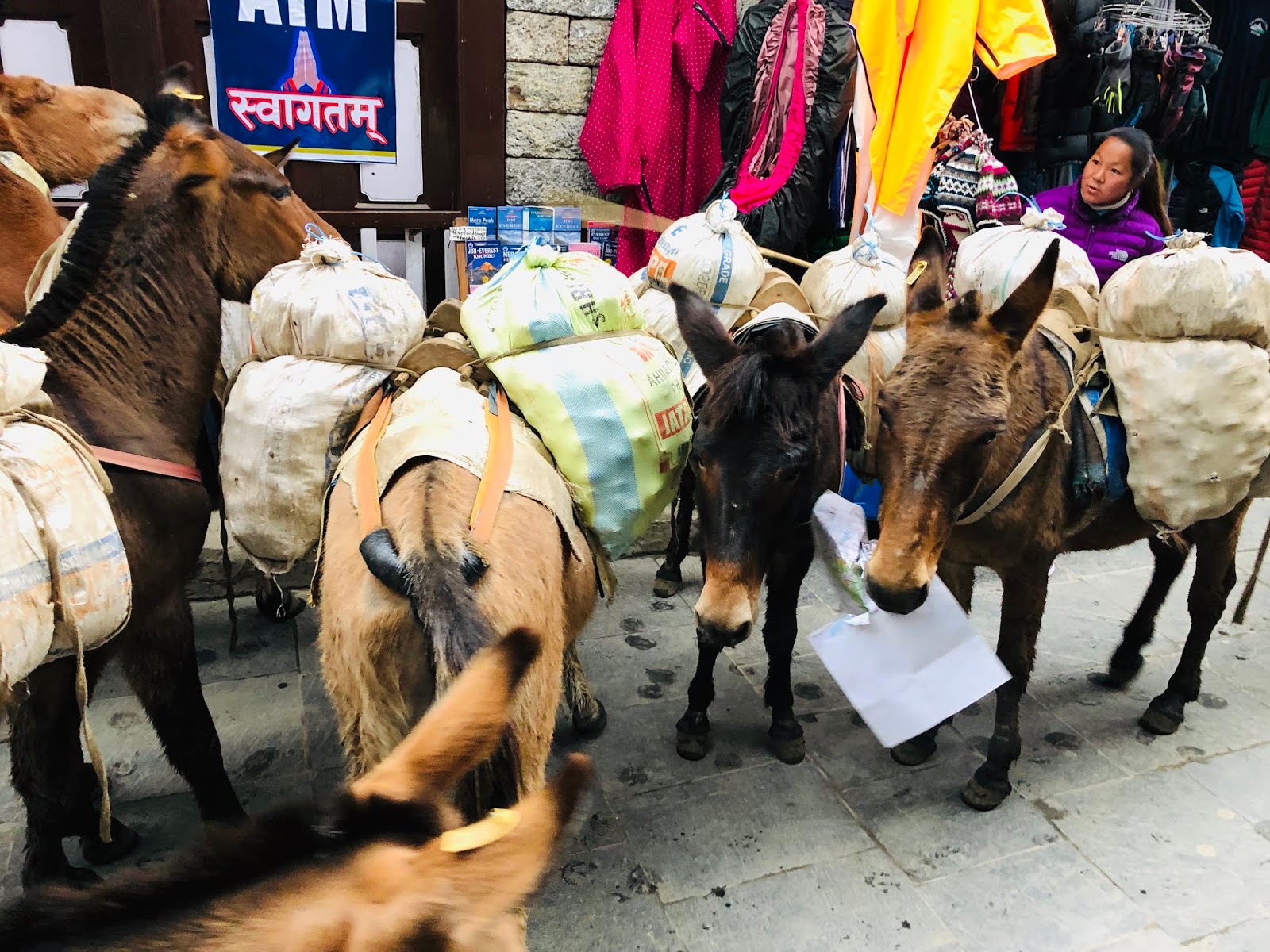
After a long and comfortable sleep at the first, but I’m sure not last, Namaste Tea House, we packed our day bags and started off on our 7km hike. We were greeted by beautiful Bhuddist Nepalese religious symbols along the way (always pass clockwise) and several herds of donkey/ mule/ yak type animals hauling 100’s of kgs of gas tanks, rice bags, and overloaded North Fake/Face 100L duffels. Why the animals, you ask? Well, there are NO roads from Lukla onwards into the valley and up the mountains.

Mules learning the route up the mountain by eating the maps.

About 2 hours of undulating, mainly downhill, terrain later, we arrived at our next rest house, the Green Village Tea Room. We had enough time for a bit of terrace sunbathing, a hot-tap shower (an added bonus), then our first Dal baht of the trip. Dal baht is a Nepalese/ Indian type dish of a lentil soup, rice, curry fried potatoes and vegetables, topped with a poppadom. As I’m sure to have another Namaste Tea House stay, I’m also sure to have more than a few more dal bahts for dinner during this adventure. With dinner done, it was time to turn in for our 6am alarm in anticipation for our long trek to Namche Bazar the following day.

April 11, 2019: Phadking (2610m) to Namche Bazar(3440m) 

What is meant to be one of the hardest days on the trek to Everest Base Camp (EBC), we woke early to get a good start on our 12km hike ahead of the blazing sun. This was such a beautiful start to our Himalayan hiking; a mix of stone and dirt zigzag pathways set amongst the evergreen and rhododendron forests. We followed the valley of the river, crossing the famous wire suspension bridges, passing herds of our hoofed animals, with views of rocky, snow-dusted peaks around each corner. 

One of several suspension bridges

Our guide tried to manage our expectations to say that we would expect a 3hr hike to Jorsalle where we could stop for lunch, with a further 3.5-4 hrs to Hilltop Tea House right at the top of Namche Bazar.  We steadily ventured at our own pace as the pack spread out and after 2 hrs got to Jorsalle. With no sign of the faster people, and over the halfway mark in terms of kilometres, we decided to continue onwards. Up and up, polé polé (slowly slowly from Kilimanjaro), we entered Sagarmatha National Park and were strictly reminded to refrain from: taking life, anger, jealousy, offending others, and taking excessive intoxicants. Sagarmatha is the Nepalese name for Mount Everest, meaning “Mother Goddess of the Earth” and is one of their deities.

First view of Everest... super zoomed.

We hit our first viewpoint of Everest at 3180m (and no sign of our team members nor another village for lunch). Robin and I armed our stomaches with Cliff and Primal Pantry bars and ploughed on. About another 40 minutes onwards, we hit the Namche check point (relief!). Unfortunately we were hit with a sting in the tail and our aptly named Hilltop Tea House which was another 100-200m ascent. 

Miraculously as usual, our bags arrived via our furry four-footed friends and we unpacked for the next two nights as we will have our rest day in Namche the following day. 

April 12, 2019: Namche Bazar(3440m) “rest” day.

“Rest” day meant an acclimatisation hike up to 3880m. Queue eye roll as this hike was effectively a 45 minute stair session (I loathe stairs) at altitude in the late morning sunshine. All worth it though, as we were rewarded at the top of our hike at the Hotel Everest View Point with real coffee from Nepal. Small wins when you’ve not had a coffee in a few days. Back down to our Hilltop abode for a spot of Sherpa Stew for lunch before wandering around the alleyways of Namche. 


Namche hosts a mix of more brightly coloured religious structures, touristic market shops, essential shops where you can buy $10 toilet paper (okay, for 4 rolls), and North Fake AND legit North Face gear for sale. We also stopped for some of that aforementioned $10 for chocolate cake before retreating to our room to finish my recount of the past week. 


We are both looking forward to the next week, where the only way is up! I’ll continue to keep you updates along the way.

Ta ta for now.